Memory Management in C and Python: A Comparative Overview
A clear comparison of memory management concepts in C and Python, covering stack vs heap, reference counting, garbage collection, and weak references.
Memory Management in C and Python: A Comparative Overview
- Memory Management in C
- Memory Management in Python
- Reference Counting and Garbage Collection (GC) in Python
- Weak References in Python
- Sources and Further Reading
1. Memory Management in C
In C programming, memory is conceptually divided into three main sections:
a) Code/Text Segment
- Stores the compiled program code (instructions).
- This is read-only and contains the executable code.
b) Stack Memory
- Used for static memory allocation.
- Stores:
- Function call frames (activation records).
- Local variables.
- Return addresses.
- Grows and shrinks automatically as functions are called and return.
- Managed by the system (compiler/runtime).
- Limited in size.
- Stack Overflow occurs when too many nested function calls or large local variables exceed stack size.
c) Heap Memory
- Used for dynamic memory allocation.
- Memory allocated at runtime using
malloc(),calloc(),realloc(). - Needs to be explicitly freed with
free()to avoid memory leaks. - Memory is borrowed from the OS.
- Larger but slower than stack.
- Memory fragmentation can occur.
Example in C:
1
2
3
4
5
6
7
int main() {
    int a = 10;       // 'a' allocated on stack
    int *ptr = malloc(sizeof(int));  // dynamic allocation on heap
    *ptr = 20;
    free(ptr);        // free heap memory
    return 0;
}
2. Memory Management in Python
Python abstracts memory management but conceptually it also uses stack and heap memory:
Key Points:
- Everything in Python is an object.
- Objects are always stored in heap memory.
- Variables/names/references are stored on the stack (or within the function/local/global scopes).
- Python variables are references (or pointers) to heap objects.
- When you write
x = 10, the integer object10exists in the heap;xis a reference to that object, stored in the current namespace (stack). - Functions, classes, and their frames (local variables) are managed on the stack.
Stack vs Heap in Python
| Stack | Heap |
|---|---|
| Stores references (variable names) | Stores actual objects |
| Manages function calls, local variables | Dynamic memory allocation for objects |
| Limited in size, managed automatically | Larger, managed by Python’s memory allocator and garbage collector |
Example in Python:
1
2
3
4
5
6
7
8
9
10
a = 10           # 'x' refers to int object 10 in heap
def fun():
    b = 20       # 'y' refers to int object 20 in heap (inside function stack frame)
    return y

class Car:
    def __init__(self):
        self.z = 10  # self.z refers to int object 10 in heap

cobj = Car()     # cobj refers to Car object in heap
A Visual undersanding of the internals 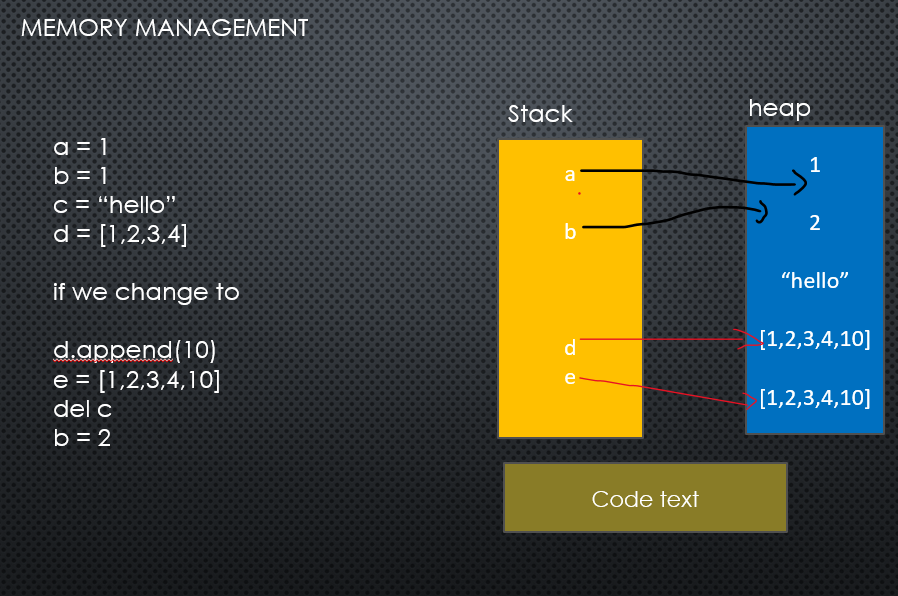
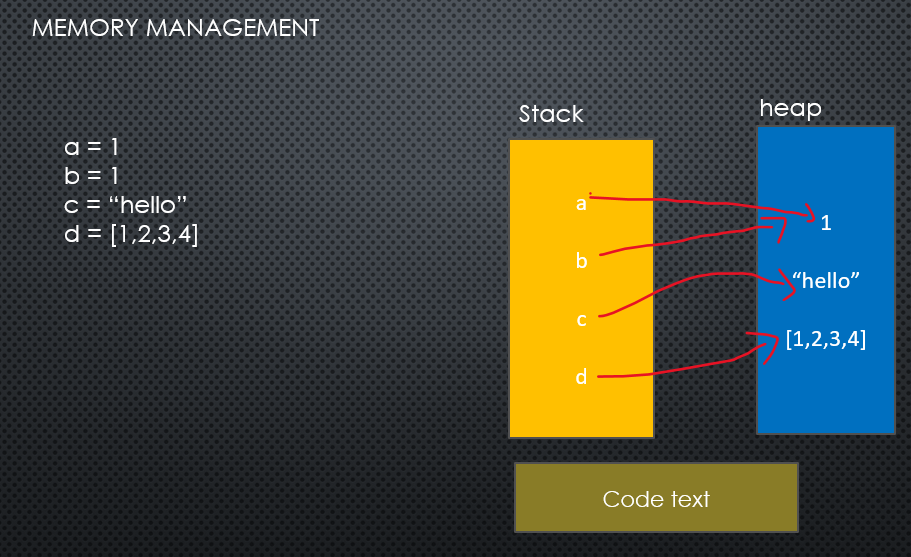
Reference Counting and Garbage Collection (GC)
Python uses reference counting as its primary memory management mechanism:
- Each object has a counter tracking how many references point to it.
- When references drop to zero, the object is immediately deallocated.
- Python also uses a cyclic garbage collector to clean up reference cycles (objects referencing each other).
Different Python Interpreters and GC:
- CPython uses reference counting + cyclic GC.
- PyPy uses a tracing garbage collector.
- Jython and IronPython use Java/.NET GCs respectively.
Reference Table Example
| Object | Number of References |
|---|---|
| car | 2 |
| 100 | 1 |
| 10 | 1 |
When an assignment like cobj = None happens, the reference to the original car object is removed. If no other references exist, it becomes eligible for garbage collection.
3. Weak References in Python
- The
weakrefmodule allows the creation of weak references. - Weak references do not increase the reference count of the object.
- Useful for caching and observing objects without preventing their garbage collection.
- You can check if an object still exists through a weak reference before it gets collected.
1
2
3
4
5
6
7
8
9
10
11
12
13
14
15
16
import weakref

class C:
    def __init__(self):
        print("Hi")

obj = C()            # strong reference
print(obj)

r = weakref.ref(obj) # weak reference
print(r)             # prints weakref object

del obj              # deletes strong reference

print(r())           # None, as object is garbage collected
Sources
- Python Documentation: Memory Management
- Python’s
weakrefmodule docs: https://docs.python.org/3/library/weakref.html - Understanding and Using C Pointers by Richard Reese
- Real Python articles on memory management and garbage collection
This post is licensed under CC BY 4.0 by the author.